
What Spencer County Deeds Show
The Spencer County Clerk keeps the paper trail for interests in land. One deed image can show the grantor, grantee, execution and recording dates, consideration, legal description, prior deed reference, signatures, acknowledgments, and even the return address. Read the whole instrument. Index text only points the way; it never replaces the image itself.
| Deed Type | What It Does | Common Use |
|---|---|---|
| General warranty deed | Conveys the stated interest with broad covenants | Ordinary arm's-length transfer |
| Quitclaim deed | Conveys only the interest the grantor may hold | Interest cleanup or family transfer |
| Commissioner's deed | Records a court-authorized conveyance | Judicial sale |
| Executor or trustee deed | Conveys through a fiduciary capacity | Estate or trust administration |
| Affidavit of descent | Documents an inheritance-related claim | Estate chain support |
A deed records the conveyance itself. A mortgage secures a debt. An assignment moves the recorded holder, and a release clears that instrument. Judgment liens, mechanic's liens, tax liens, lis pendens, easements, and restrictions each demand their own review. One item's presence or release proves nothing about the rest.
Spencer County Deed Access
The Legal Records Department sits at 2 West Main Street in Taylorsville, and its number is 502-477-3215. Hours run Monday through Wednesday and Friday, 8 a.m. to 4:30 p.m. Thursday runs until 6:30 p.m. The last Saturday opens 8 a.m. to noon. Viewing at the office is free.
The clerk reports most courthouse documents spanning 1795 to the present, most indexes reaching roughly 1880 with exceptions, and online images covering most instrument filings from January 1795 onward. Treat those as broad claims. Confirm the exact book, series, and image quality.
eCCLIX Deed Record Access
Remote Spencer County deed records run through eCCLIX. Registration is required. It is not an open, unlimited web index. The public account carries a $200 setup fee plus $65 each month, while a single-day account costs a $45 setup fee plus $15 per 24 hours. Each extra user adds $10. Public accounts operate from 9 a.m. to 7 p.m., exclude weekends, and allow five searches per day.
Search boxes and result columns appear only after login. Apply through the clerk's mail, fax, or email process. The counter also works when remote terms do not fit the task.
The clerk's online land-records page documents eCCLIX account types, charges, and public-user limits.
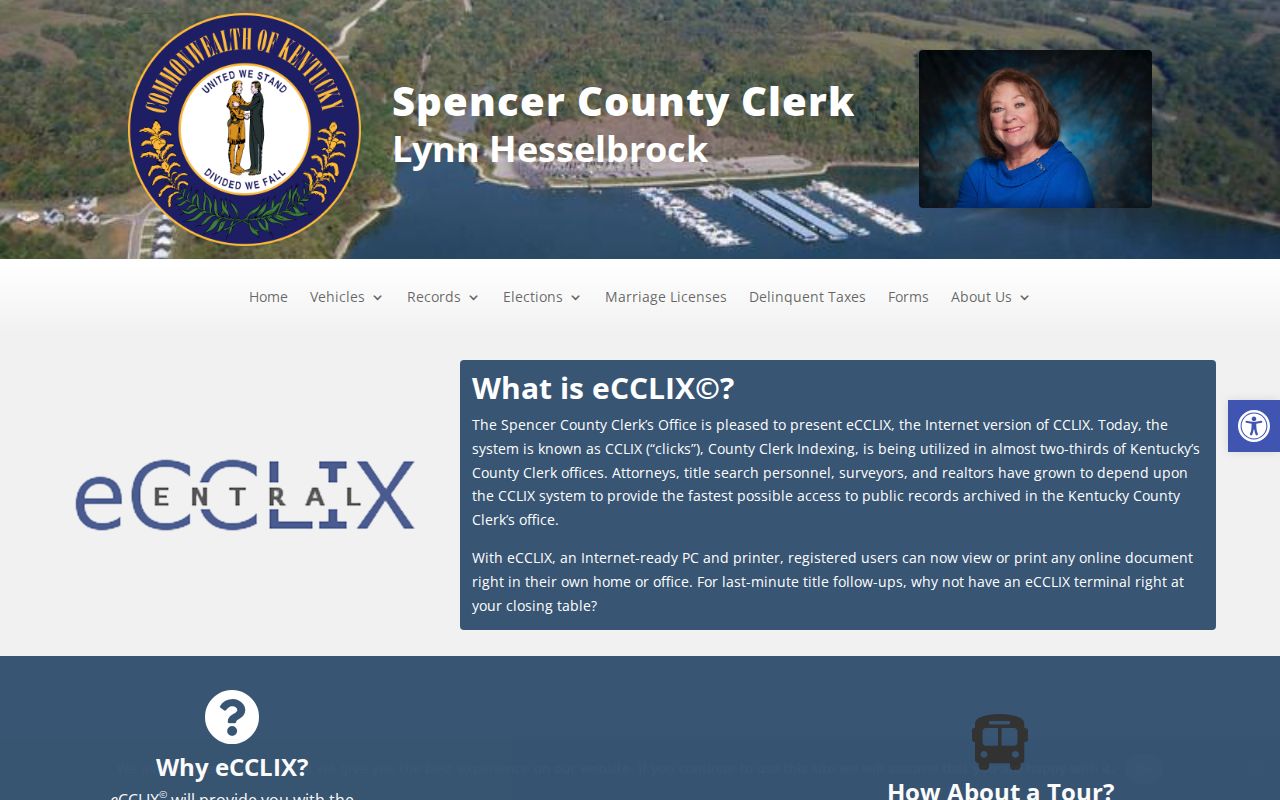
It shows account terms, not actual index results.Keep in mind that the screen displays eCCLIX access terms rather than an authenticated Spencer County deed-index result.
Use Spencer's Grantor-Grantee Index
A backward chain starts with the newest verified conveyance. Search the current owner as grantee. Open that acquisition deed, note the named grantor and prior deed reference, and then search that grantor as a grantee in an earlier period. Repeat the loop while confirming the legal description still covers the same land.
- Find the current acquisition deed under the grantee's full name.
- Record its date, type, book/page, legal description, and prior reference.
- Search the named grantor as an earlier grantee, including spelling and capacity variants.
- Repeat through each matching deed, then move to books, microfilm, archives, or predecessor counties.
- Grantor
- The party that transfers a stated interest.
- Grantee
- The party that receives the stated interest.
- Chain of title
- The linked sequence of instruments affecting the land.
- Book/page or instrument number
- The clerk's retrieval key for a recorded document.
Read Spencer Legal Descriptions
Match the land, not just the people. A Spencer deed may rely on lot and block, a recorded subdivision plat, metes and bounds, acreage, a road or creek call, or a prior book and page. Pull every plat incorporated by reference. An address is only a locator and may change, while the legal description carries the conveyance.
The county's minor-plat checklist flags the elements worth reconciling: lots, adjoining record owners, rights-of-way, easements, utilities, setbacks, scale, a north arrow, and survey certification. GIS helps orient a tract. It will not settle a disputed line.
Historic Spencer Deed Books
Spencer County formed in 1824 from Bullitt, Nelson, and Shelby counties. A chain reaching that year may continue in a parent county's books. KDLA's land inventory covers deeds from 1824 through 2011. Wills and tax books come alongside them. Weigh that inventory against the clerk's broader claim. Most documents there date from 1795, the clerk says.
Records survived Taylorsville fires in 1865 and 1913, official accounts say. Ask which volume survives. Do not presume loss or completeness, and watch handwritten indexes for alternate spellings and initials.
Spencer Deed Fees
The clerk's table charges $50 to record a deed. A plat or easement runs the same $50. An affidavit of descent or real-estate conversion also costs $50. Many types add $3 per page after the first five pages. These are recording charges, not a blanket copy price, so check the table before paying.
The open-records policy prices noncommercial paper copies at fifty cents per page and media copies at $5. Postage and applicable costs are paid in advance. A certified copy may carry a separate statutory charge. Identify the need first. Viewing, a plain copy, a certified copy, and recording a new instrument all differ.
Spencer Mortgages and Releases
Mortgages travel with deeds in the Spencer County records. Assignments, modifications, releases, judgment liens, mechanic's liens, lis pendens, and tax liens all sit in the same deed records. To trace encumbrances, search forward from the acquisition date and match each instrument to the legal description or the source document it references. One release only clears one mortgage. It proves nothing about a later mortgage or an unrelated lien.
A lis pendens works differently. It is a recorded notice tied to live litigation, so take its case reference to the Spencer Circuit Clerk or CourtNet and follow the docket through judgment, sale, confirmation, and any deed that follows. Index order alone never settles legal priority.
Spencer County Doc Alert
Doc Alert is the clerk's watch service. Register a name, a business name, and an email. The clerk then sends notice whenever a deed or mortgage bearing that name is recorded. It works best once the existing deed baseline is already known. An alert flags activity only. It cannot judge whether a filing is valid or fraudulent.
When a notice arrives, read the recorded copy itself. Check the parcel connection, the legal description, and the signer's capacity. A name match can simply be another person or entity. Title insurance and legal review cover the risks an alert cannot.
Obtain a Spencer County Deed
Three routes lead to a Spencer County deed copy. Use the online account when its terms fit. View the index and image at the clerk's office, or send a focused request by mail, hand delivery, fax, email, or phone. Include the grantor and grantee, an approximate date, the instrument type, any parcel or legal-description clue, and a known book or page. The clerk's policy allows five working days for an availability determination. Weekends and legal holidays are excluded.
Archival volumes are a different errand. Ask KDLA for those, giving the county, series, date, and volume reference. Note the copy source and the retrieval date. A certified copy authenticates the office copy, but it still is not a title opinion.
Recorded, not guaranteed. Spencer County deed records show what the clerk accepted and indexed. They do not guarantee clear title, settle boundaries, or rule out unrecorded interests.
Estate Transfers in Spencer Deeds
Ownership chains often pass through estates. The instrument may be a will or an affidavit of descent. It may also be an executor's deed, a trustee's deed, a death certificate used for an allowed name change, or a court order. The PVA requires an official recorded document, such as a deed or will, to change an ownership name. A death certificate works only for a qualifying change. That update does not replace the papers explaining how the interest passed.
When a decedent appears, search the clerk's wills and affidavits alongside the deed index. If the instrument points to probate, check the Spencer Circuit Clerk. Record each role exactly as written. Executor, administrator, trustee, and a person acting alone are distinct capacities. Match the land by legal description, never by family surname alone.
Older estate work may need KDLA. Its Spencer inventory holds wills from 1824 through 2009 plus deed and tax series. Search name variants and approximate dates while keeping uncertain identities separate. An affidavit or will may explain succession without being the final conveyance. Follow the later deeds, releases, and court orders. The records will show how the claimed interest reached the next party.
Abstract every link in the chain. List the parties for each deed. Also list their capacities, execution and recording dates, instrument type, book and page or number, and consideration if shown. Include the legal description, prior reference, and image source. Corrections, affidavits, releases, and plats belong on the list as separate records. Do not fold them into the deed itself.
If no deed turns up, write down the exact names, years, and index types tried. Check the reverse side of the grantor-grantee index, variant spellings, entity names, and predecessor counties. Then ask the clerk or KDLA for the specific volume. A failed remote query never proves a transfer went unrecorded.